
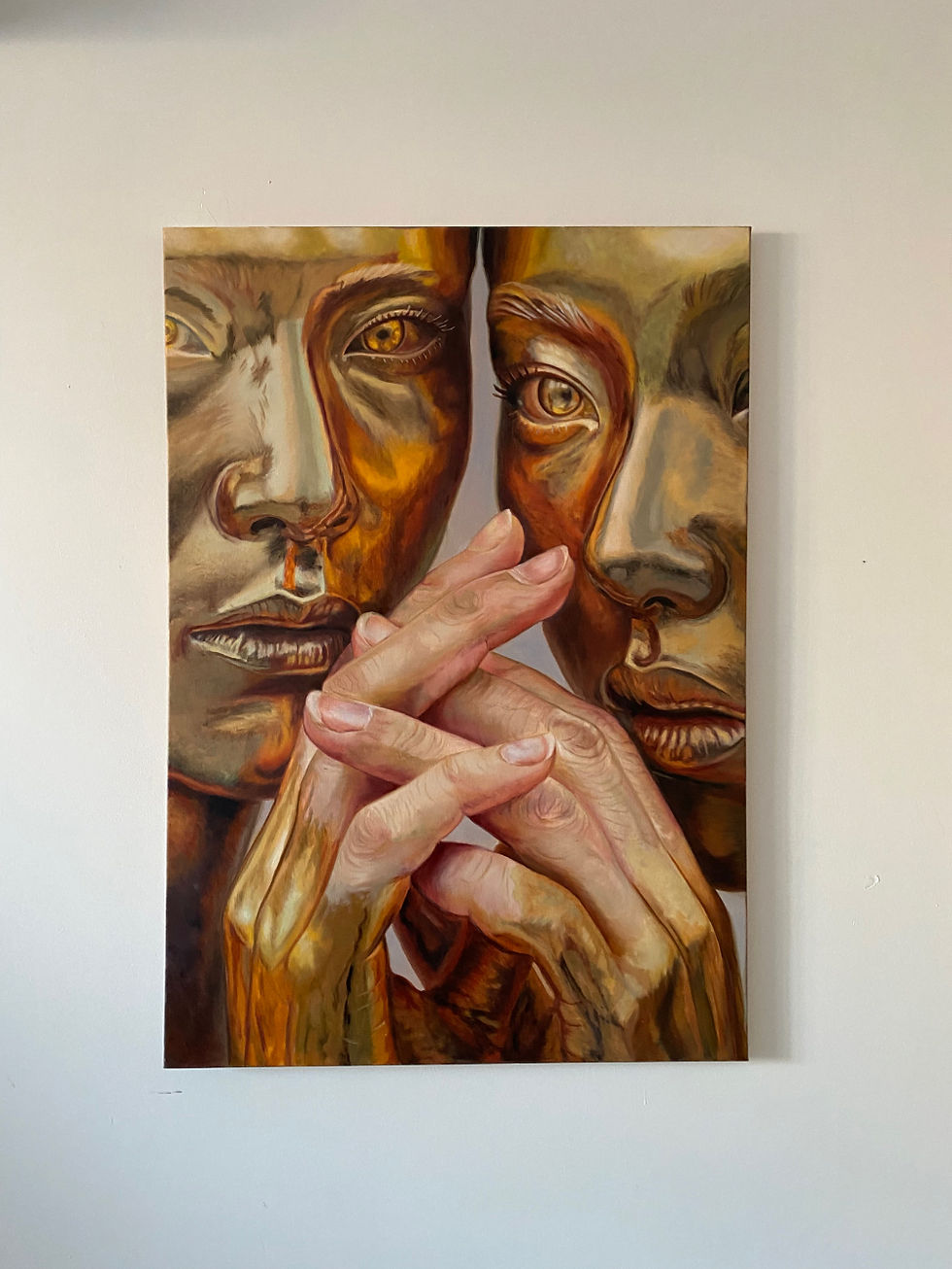
HIDE AND SEEK - The artist's dilemma of searching for solitude and fear of not being found.

Newton's observation of an apple falling from his garden while school was closed inspired him to develop the law of universal gravitation. Archimedes is said to have discovered the principle of buoyancy while taking a bath.Creation often finds its own way when one is alone, without other distractions around. This is perhaps why musicians, writers, painters, entrepreneurs, and creative individuals, while seeking witness to themselves externally, are also in search of solitude.
But why does the feeling of loneliness weigh so heavily ?
Because in this sense, creative individuals, when alone, are not confined to themselves and their work. There, they stand to see, feel, and make visible something the world has not yet seen. They feel the burden of the entire collective on their shoulders.
The artist notices things that society hasn't yet become aware of, hasn't yet seen, or isn't ready to see. Some things are felt before they become visible.
Canadian psychologist and academic Jordan Peterson uses a metaphor about the artist that beautifully illustrates this;
Imagine a society living on a large piece of land, surrounded by a cliff. The artist is the person walking on the edge of that cliff. One foot is in the known, the other in the unknown. They go to the boundary of the unknown, and bring back what they see and feel there. In this way, the boundaries of the world known to the society expand a little more.
But walking on the edge of a cliff is risky. One could easily lose his/her balance and find himself at the bottom.
Vincent Van Gogh spent the last years of his life in a psychiatric hospital suffering from serious psychological problems. Despite going through a difficult period mentally, he produced a significant portion of his works, now considered masterpieces, alone in his hospital room. Sometimes, extraordinary creation can emerge from a person's darkest, most difficult times. Diamonds form under high pressure. But at what cost?

Another risk for an artist walking on the edge of a precipice is that society may not readily accept what is different from itself. Sometimes, it may even push the different person off the cliff. Resistance to change is inherent in human nature.
Unlike his contemporaries, El Greco used excessively elongated human figures, artificial lighting, and unrealistic color tones. The Spanish Inquisition and church authorities viewed his mystical style as disrespect for religious rules and dramatic heresy. He did not receive the respect he deserved in his time, was ostracized, and was completely forgotten for centuries after his death. However, he was rediscovered by modern artists in the late 19th century and declared an early progenitor of Expressionism. His once-unconventional style later paved the way for modern art.

Perhaps the issue isn't sometimes that the artist is sharp, different, or wrong. Perhaps it's simply that they are ahead of their time.
The artist's dilemma begins here: should he ignore his instincts and wander in the middle, in the average, to avoid falling into the abyss, or should he venture to the extremes, risking slipping or being pushed off the cliff? Either way, it's a loss.
Therefore, the artist's solitude, his walking on the edge of the abyss, must be conscious.
He should be alone, hide, be silent, and feel.
But then it must reappear.
Among people, into life, into the everyday.
Because perhaps the artist's true mastery lies not only in being alone, but also in being able to return from solitude. Like a game of hide-and-seek, you don't hide forever. Even if no one can find you, you knowingly get caught. And at that moment, you bring into the world what you found while hiding; a painting, music, writing, an idea, an invention, a feeling, perhaps something that no one has yet named.
Walking with the skill of a tightrope walker on the edge of a precipice is vital for the artist's well-being and the sustainability of their work. To achieve this, they must always include a few trusted playmates who can find them. Not to praise or admire their work or ideas, but to support them when they lose their balance on the tightrope, to find them when they can't get out of hiding. Without judgment, simply by being there for them. Those few creative individuals, that safety net, those playmates who will tag you…
Ahsen Küçükçalık
Subscribe so I can continue posting these kinds of content.
Contact me for artist consulting and mentoring .
Let me be by your side on your journey.


Comments